
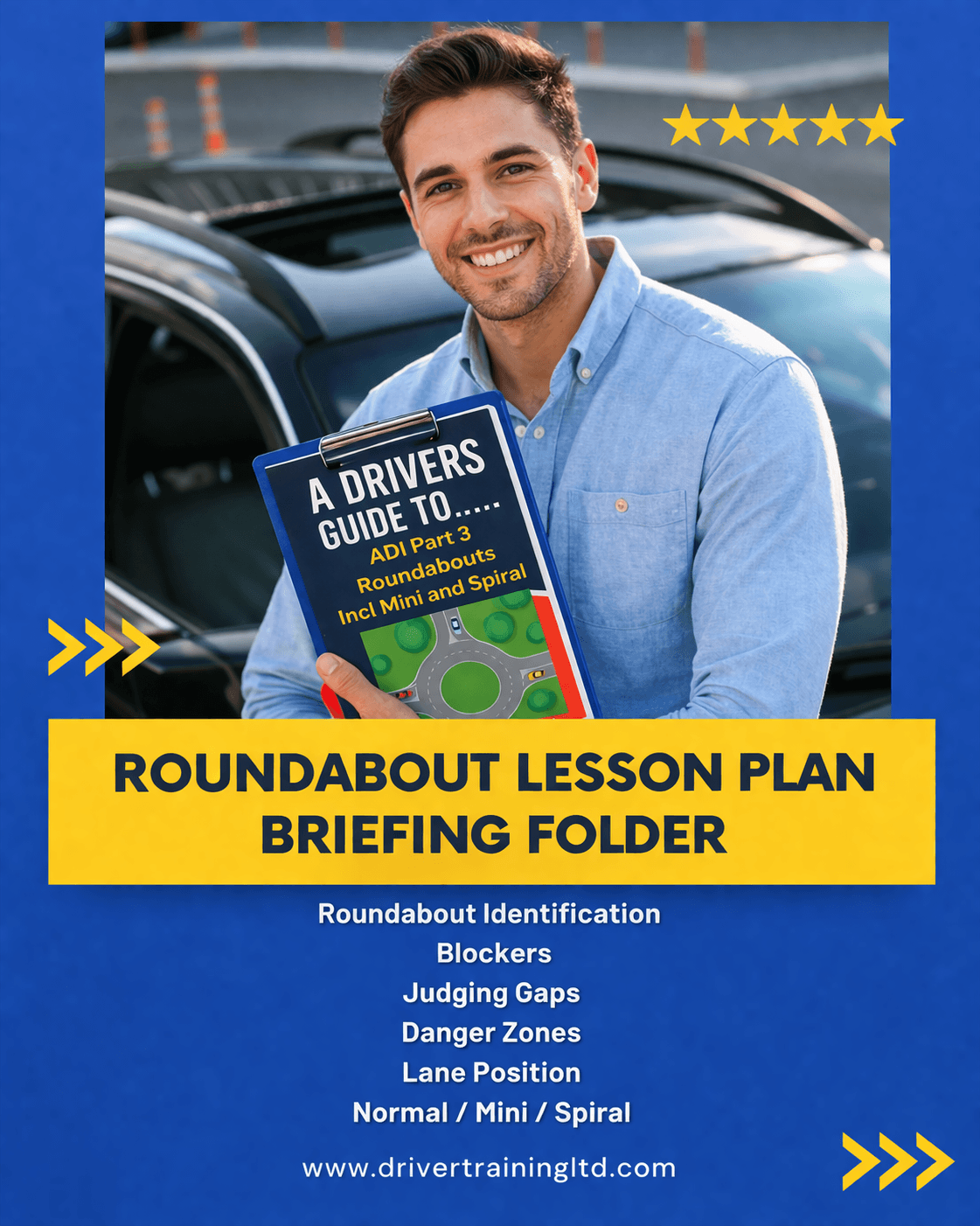
How to Teach Roundabouts (ADI Part 3 Guide)
Table of Contents
- How to Teach Roundabouts for ADI Part 3
- 1. Start With Identification (Set the Foundation)
- 2. Open or Closed? (Critical for Risk Management)
- 3. MSPSGL Routine (Structure Creates Safety)
- 4. Observations (Where Most Faults Begin)
- 5. The Danger Zone (Gap Judgement Made Simple)
- 6. Blockers (Advanced Awareness)
- 7. Lane Positioning (Clarity Over Confusion)
- 8. Car First, Road Second (Modern Teaching Standard)
- 9. Build Independence (Don’t Over-Instruct)
- 10. Review and Reflect (Lock in Learning)
- Key ADI Part 3 Takeaway
- Q&A Section
- FAQs
How to Teach Roundabouts for ADI Part 3
Teaching roundabouts properly is one of the clearest ways to demonstrate high-level competence on your ADI Part 3 test. This is where examiners quickly see the difference between someone who simply instructs… and someone who truly teaches.
The goal is not just to get the pupil around the roundabout safely. The goal is to develop their understanding, decision-making, and independence.
If you approach roundabouts as a structured, client-centred process, you tick all three key areas of the marking sheet:
- Lesson Planning
- Risk Management
- Teaching & Learning Strategies
Let’s break it down properly.
1. Start With Identification (Set the Foundation)
Before you even talk about lanes or signals, your pupil must be able to recognise a roundabout early.
Teach them to look for:
- Roundabout warning signs
- Road markings (triangle give way lines, circular layout)
- Changes in road flow
Coaching approach:
“What tells you this is a roundabout?”
This builds awareness rather than dependency.
2. Open or Closed? (Critical for Risk Management)
This is where many trainees fall short.
A pupil must learn to identify whether the roundabout is:
- Open → clear visibility, early decisions possible
- Closed → restricted view, decisions delayed
Use simple prompts:
“What can you actually see from here?”
“Is anything hidden?”
This links directly to speed choice and observation timing.
3. MSPSGL Routine (Structure Creates Safety)
Now bring in structure:
- Mirrors
- Signal
- Position
- Speed
- Gear
- Look
But don’t just recite it. Make it meaningful.
Instead of:
“Do your mirrors”
Say:
“Why are we checking mirrors before slowing?”
You’re building understanding, not habit.
4. Observations (Where Most Faults Begin)
Teach observations as:
Right → Ahead → Left → Ahead → Right
Why?
Because if you removed the roundabout, it’s a crossroads.
Key teaching point:
Do not rush the decision.
Coach it like this:
“What are you waiting for?”
“What would make it safe?”
5. The Danger Zone (Gap Judgement Made Simple)
Introduce the concept of the danger zone:
- Vehicles between 3 o’clock and 7 o’clock (clockface view)
If a vehicle is in that zone, it is unsafe to go.
This simplifies decision-making without overloading the pupil.
6. Blockers (Advanced Awareness)
Now develop their thinking further.
Explain blockers:
- Vehicles already on the roundabout that prevent others from entering
- These can create safe gaps
But be very clear:
Not every blocker creates a safe gap
Coaching question:
“Is that gap actually protected?”
7. Lane Positioning (Clarity Over Confusion)
Keep it simple:
- Left for left
- Right for right
- Straight ahead depends on markings
Then expand:
“Don’t follow rules blindly—read the road markings.”
This shows flexibility and real understanding.
8. Car First, Road Second (Modern Teaching Standard)
This is a key upgrade in teaching quality.
Teach pupils to read:
- Speed
- Position
- Indicators
- Behaviour
- Wheel direction
Because vehicles don’t always follow the layout.
Coaching line:
“What is that car actually doing?”
9. Build Independence (Don’t Over-Instruct)
Many trainees fail here.
Avoid:
Constant instructions
Instead:
Ask, guide, confirm
Example:
“What lane do you need here?”
“What are you looking for before you go?”
Let them think.
10. Review and Reflect (Lock in Learning)
At the end:
- Ask what went well
- Ask what could improve
- Link back to goals
Example:
“What did you notice about your gap judgement today?”
This is where learning sticks—and where examiners see real coaching.
Key ADI Part 3 Takeaway
Roundabouts are not about getting through them.
They are about:
- Structured planning
- Clear risk management
- Developing independent decision-makers
That’s what gets you into the higher grades.
Q&A Section
1. What is the most common mistake trainees make when teaching roundabouts?
They focus too much on giving instructions instead of developing the pupil’s understanding and decision-making.
2. Should I always teach the same routine at every roundabout?
No. The structure stays the same, but the application must adapt to the size, layout, and visibility of each roundabout.
3. How do I know if I’m being too instructor-led?
If the pupil is relying on you to tell them when to go or what to do, you’re not building independence.
4. Is it okay if the pupil hesitates too much?
Yes—early on. Hesitation is often safer than rushing. Your role is to refine their judgement, not remove caution.
5. What is the examiner really looking for during roundabouts?
They are looking at how you:
- Identify risk early
- Adapt your teaching
- Develop the pupil’s understanding
Not just whether the pupil gets through safely.
