Roundabout Blockers What are they?
Table of Contents
- Blockers on Roundabouts (Full Guide)
- What are Roundabout Blockers?
- Why Roundabout Blockers Matter
- A Simple Example
- The Golden Rule
- How to Teach Blockers Properly
- Timing Is Everything
- The Biggest Mistake Learners Make
- Multi-Lane Roundabouts (Where It Gets More Complex)
- Car First, Road Second
- When Blockers Do NOT Work
- Linking Blockers to the Danger Zone
- Coaching Questions That Work
- Building Confidence Without Creating Risk
- Common Learner Errors
- Blockers on roundabouts
- FAQs
Blockers on Roundabouts (Full Guide)
If you want to take a learner from hesitant to confident at roundabouts, this is the concept that makes the biggest difference: understanding roundabout blockers.
Most learners are taught one rule:
“Give way to the right.”
That’s correct—but incomplete.
Because in real driving, the flow of traffic constantly changes. And sometimes, the traffic on the roundabout actually helps you.
That’s where blockers come in.
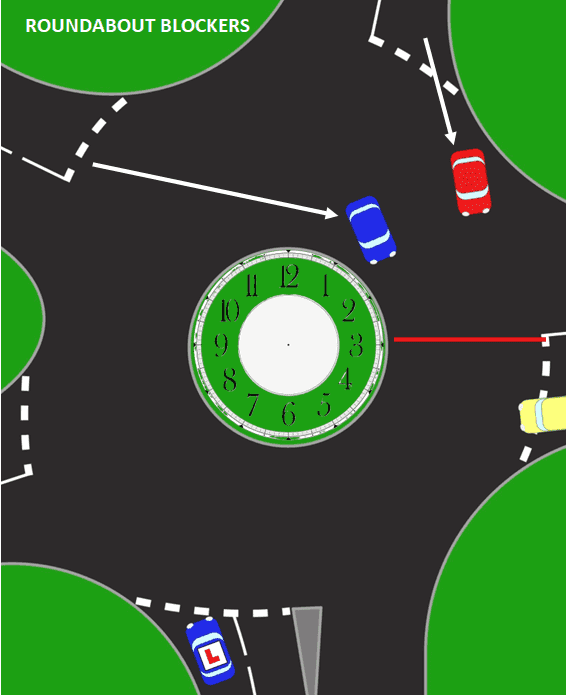
What are Roundabout Blockers?
roundabout blockers are:
vehicles already on the roundabout that prevents other vehicles from entering from your right.
In simple terms:
It “blocks” the traffic you would normally have to give way to.
This can create a safe opportunity to join the roundabout.
Why Roundabout Blockers Matter
Without understanding blockers, learners tend to:
- Wait too long
- Miss safe gaps
- Lose confidence
They see traffic on the right and assume:
“I can’t go.”
But an experienced driver sees something different:
“That car is stopping the next one from entering—I’ve got a gap.”
A Simple Example
Imagine this:
- A car is coming from your right
- It enters the roundabout
- As it travels past, it physically blocks the next car behind it
That moment—when the second car cannot enter—is your opportunity.
But only if it’s actually safe.
The Golden Rule
A blocker can create a gap.
It does NOT guarantee a safe gap.
This is where many learners go wrong.
How to Teach Blockers Properly
Start by getting the pupil to see the pattern.
Ask:
“What is that car doing to the traffic behind it?”
Then:
“Is it stopping them from entering?”
Then:
“What does that mean for us?”
You are training their awareness—not just their reactions.
Timing Is Everything
A blocker only works if you act at the right time.
Too early:
You move into danger.
Too late:
The gap disappears.
This is why hesitation is such a big issue.
Coach it like this:
“When will that space be at its safest?”
The Biggest Mistake Learners Make
They assume:
“If one car goes, I can go after it.”
That is not always true.
Why?
Because:
- Another car may be close behind
- A vehicle may accelerate quickly
- A second lane may still be active
So always reinforce:
“What else could affect us?”
Multi-Lane Roundabouts (Where It Gets More Complex)
On larger roundabouts:
- One lane may be blocked
- Another lane may still be flowing
So a blocker in one lane does not mean the whole roundabout is safe.
Teach:
“Which lane is affected—and which one isn’t?”
Car First, Road Second
This is where blockers really come alive as a teaching tool.
Don’t just look at the layout.
Look at the vehicle:
- Speed
- Position
- Indicators
- Lane discipline
- Behaviour
Ask:
“Is that car controlling the situation—or reacting to it?”
This helps pupils predict what will happen next.
When Blockers Do NOT Work
This is crucial for ADI Part 3.
A blocker is unreliable when:
- The following vehicle is too close
- The second vehicle accelerates
- There are multiple lanes in use
- The view is restricted (closed junction)
So always confirm:
“Is that gap protected—or could something still appear?”
Linking Blockers to the Danger Zone
Blockers directly affect the danger zone.
Normally:
Traffic between 3 and 7 o’clock = unsafe
But a blocker can temporarily “clear” that zone.
However:
The zone can fill again very quickly.
So teach:
“Is the danger zone staying clear—or just briefly opening?”
Coaching Questions That Work
Use these in lessons:
- “What is that car doing to the traffic behind it?”
- “Is anything still able to enter from the right?”
- “Which lane is still active?”
- “What might happen next?”
- “Is that gap protected?”
These questions develop anticipation—the key to confident driving.
Building Confidence Without Creating Risk
Blockers help reduce hesitation—but only if taught correctly.
You are not encouraging the pupil to:
“Take chances”
You are teaching them to:
Recognise safe opportunities
That’s a big difference—and one examiners notice immediately.
Common Learner Errors
- Following the first car blindly
- Ignoring second-lane traffic
- Misjudging speed of approaching vehicles
- Moving too early before the gap forms
- Waiting too long and missing the gap entirely
Your job is to fine-tune their timing and judgement.
Blockers on roundabouts
Blockers are not a shortcut.
They are a tool for understanding how traffic actually behaves.
When a learner understands blockers, they stop guessing—and start reading the road properly.
That’s the step change from basic driving to confident, independent driving.
FAQs
What exactly is a blocker in simple terms?
A blocker is a vehicle on the roundabout that prevents other traffic from entering, which can create a temporary safe gap.
Can I always go when there is a blocker?
No. A blocker can create a gap, but you must still check that no other vehicles can affect you.
Why do learners struggle with blockers?
Because they focus only on giving way to the right and don’t understand how traffic flow changes in real situations.
Are blockers more important on busy roundabouts?
Yes. They are most useful where traffic is constant, as they help identify safe opportunities to move.
What is the biggest teaching mistake with blockers?
Telling pupils to “go after that car” instead of helping them understand why the gap is safe—or not safe.