Roundabout Blockers Explained
Table of Contents
Roundabout blockers — simple explanation
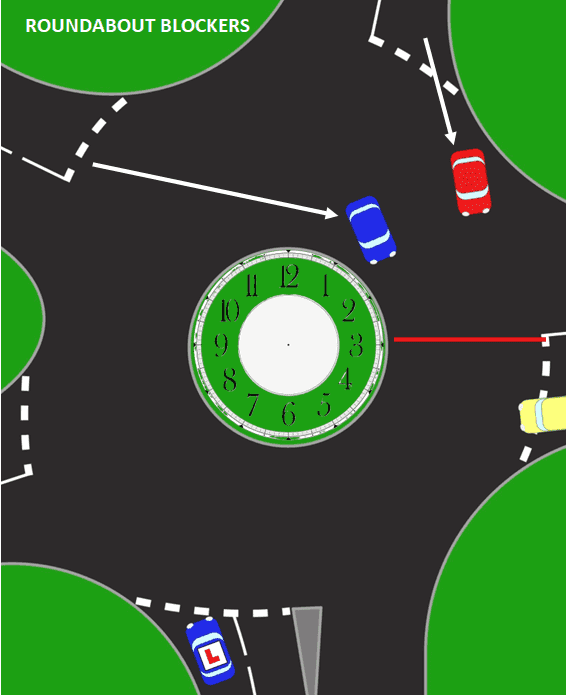
Roundabout blockers exlained - A roundabout blockers what are they and how do you deal with tem is a vehicle already travelling on the roundabout that prevents traffic from your right from continuing, which can create a safe gap for you to go.
https://drivertrainingltd.com/products/roundabouts
In other words, the blocker is not helping you on purpose. It is simply occupying the space and holding back the traffic that would otherwise cut across your path.
Simple example
Imagine you are waiting to emerge at a roundabout.
Normally, you are looking to the right and judging whether the approaching traffic is close enough, fast enough, or likely to affect you.
Now picture a large lorry, bus, or even a car coming around the roundabout from your right and passing in front of the entry to your right-hand side.
As that vehicle moves across, it may hold back the vehicles behind it or stop another stream of traffic from entering.
That vehicle becomes a blocker.
The result is that, for a brief moment, you may have a protected gap behind it.
The key teaching point
The pupil must not just look for an empty roundabout.
They should learn to look for:
what is coming
what is being held up
whether the blocker is genuinely creating time
whether the gap is big enough for their speed and ability
That is the difference between basic gap judgment and proper roundabout reading.
Examiner-safe explanation
A blocker is:
A vehicle on the roundabout that restricts or delays other traffic, especially traffic from the right, and in doing so may create a usable gap for the waiting driver.
The important phrase is may create a usable gap.
Not every blocker produces a safe gap.
That is where many learners get it wrong.
What learners often do wrong
A common learner mistake is to think:
“Something big has gone past, so I can go.”
But that is far too simplistic.
Because they still need to check:
Is another vehicle overtaking around it?
Is a motorcycle hidden behind it?
Is traffic from the right still moving?
Is the gap long enough for the move to be completed safely?
A blocker can be helpful, but it is not a guarantee.
Good coaching question
A good question for a pupil is:
“What is that vehicle doing to the traffic behind it?”
That gets them analysing the developing picture instead of just staring at the first vehicle.
Another useful one is:
“Has it created a gap, or does it only look like one?”
That is a very good ADI Part 3 type question because it develops hazard awareness and judgment.
Simple phrase for pupils roundabout blockers
You could teach it like this:
“A blocker is a vehicle that buys you time.”
That is easy to remember.
But then follow it up with:
“Bought time still has to be checked.”
That keeps it safe and stops the pupil from gambling.
roundabout blockers In everyday language
It is a bit like someone holding a door open in a busy hallway.
For a moment, the flow changes, and you get a chance to move.
But you still need to make sure no one else is rushing through behind them.
That is exactly how a blocker works on a roundabout.
ADI Part 3 teaching angle roundabout blockers
If you are teaching this on Part 3, the examiner would want to see that you:
identified the pupil’s need to improve gap judgment
explained blockers in a clear, simple way
used questions to develop the pupil’s own analysis
kept risk under control
helped the pupil understand that blockers assist judgment but do not replace observation
That is much better than simply saying:
“Use the blocker.”
Because that can sound like a script rather than proper teaching.
FAQs
What is a blocker at a roundabout?
A blocker at a roundabout is a vehicle already circulating that prevents or delays other traffic, especially traffic from the right, from joining or continuing. This can create a usable gap, but the driver must still check carefully that it is genuinely safe to emerge.
Do blocker vehicles always mean it is safe to go?
No. A blocker can help create time and space, but it does not guarantee a safe gap. The driver still needs to check for hidden vehicles, motorcycles, changing traffic flow, and whether the gap is large enough for their speed and ability.
Why is teaching roundabout blockers important for ADI Part 3?
It is important because it shows the trainer can help the pupil read developing traffic situations rather than just follow fixed rules. It links directly to observation, planning, risk management, and fault analysis, all of which are vital in the ADI Part 3 test and Standards Check.
How should driving instructors explain blockers to learners?
A simple way is to say that a blocker is a vehicle that may “buy you time” by holding back other traffic. Then the pupil should be taught that bought time still needs to be checked with good observation and sound judgement before deciding to emerge.
What mistakes do learners make with roundabout blockers?
A common mistake is assuming that once a large vehicle passes, they can go straight away. In reality, they may miss a motorcycle, a car following closely behind, or traffic still moving from the right. Good teaching helps the pupil analyse the whole picture, not just the first vehicle.